- Li's Newsletter
- Posts
- 🧂 Inside 150 deep tech websites: How complex technology gets explained
🧂 Inside 150 deep tech websites: How complex technology gets explained

Li Zeng
March 07, 2026
Over the past few months, we analyzed 150 deep tech landing pages across industries including AI infrastructure, semiconductors, aerospace, defense, robotics, energy, and climate technology.
The goal was simple: How do companies selling extremely complex technology explain what they do clearly—and credibly—on their websites?
Deep tech products present a very different communication challenge than typical SaaS products. They are harder to understand, the buying cycles are longer, and the stakes are significantly higher. Decisions often involve engineers, executives, procurement teams, and sometimes governments.
Because of this, deep tech websites follow very different design and messaging patterns than most startup websites.

The homepage isn’t a funnel
Most SaaS websites are designed around conversion. The homepage tries to push visitors quickly toward a free trial, demo, or signup.
Deep tech websites work differently. Their primary job is to answer a deeper question: “Should this company exist?”
When technologies are unfamiliar and investments are large, credibility matters more than speed. As a result, deep tech homepages frequently emphasize signals of legitimacy: press coverage, institutional partnerships, government relationships, origin stories, and large-scale manufacturing or deployment environments.
The site is less about capturing leads and more about establishing trust and seriousness.

Deep tech messaging is built around long time horizons
Another consistent theme across deep tech websites is the way companies talk about time.
Instead of emphasizing speed and rapid iteration, messaging tends to highlight durability and operational reliability. Many companies frame their products as infrastructure, not software.
Language across these sites often references mission readiness, sovereign capabilities, operational resilience, and systems designed to operate for decades.
The visual storytelling reinforces this idea. Large facilities, utility-scale infrastructure, manufacturing environments, and deployed hardware appear frequently throughout these websites.
The underlying message is simple: This technology isn’t a prototype. It’s built to operate at scale.

The five hero messaging archetypes
Despite the diversity of industries in deep tech, hero sections tend to follow a few recurring messaging patterns.
Some companies lead with a bold performance claim, highlighting speed, efficiency, or cost advantages. Others take a mission-driven approach, positioning their technology as essential for national security, climate progress, or advancing humanity.
A third approach emphasizes category leadership, using language like “the first,” “the only,” or “the world’s most advanced.” These companies are often defining entirely new technological categories.
Some companies choose the opposite strategy and rely on plain-language product explanations, clearly describing what the technology does without dramatic claims.
And in cases where companies serve multiple sectors, the hero sometimes functions as a navigation layer, allowing visitors to immediately choose the industry most relevant to them.
Different approaches, but the same objective: helping visitors quickly understand what problem the company solves and why it matters.
What actually works in deep tech hero sections
Beyond messaging style, successful hero sections tend to follow a similar structure.
The strongest examples typically include a short, confident headline focused on an outcome rather than a feature. A supporting subheadline then adds constraints such as power efficiency, cost advantages, or scalability.
Visuals also play a critical role. Instead of abstract graphics, deep tech companies frequently show real systems, hardware, facilities, or credible simulations of how their technology operates.
Finally, the hero usually contains one primary action, keeping the interaction simple and focused.
The most important moment on the page
Across nearly every deep tech website we studied, there is a moment where the page transitions from storytelling to evidence.
We call this the credibility pivot.

After introducing the idea or vision, the page quickly shifts toward proof: system diagrams, architecture illustrations, benchmark charts, manufacturing facilities, institutional partnerships, and deployed-at-scale metrics.
This moment is critical because belief in deep tech rarely comes from marketing language alone.
It comes from evidence that the technology works in the real world.
Visual design carries much of the explanation
Deep tech products often involve systems that are difficult to explain through text alone. As a result, visual design plays a major role in helping audiences understand the technology.
Across the websites we analyzed, three dominant visual styles appeared repeatedly.
Some industries—especially AI infrastructure, aerospace, and defense—use dark, cinematic aesthetics that communicate ambition and technological power.

Other sectors, particularly manufacturing and energy, lean toward clean, institutional design systems that signal safety, reliability, and operational trust.

A third group blends these two approaches, combining darker innovation-focused elements with cleaner industrial presentation.

Design techniques that reduce complexity
The most effective deep tech websites consistently use design to simplify complicated systems.
Instead of dense paragraphs, they rely on large typography with generous spacing and modular card layouts that make information easier to scan. Many sites also feature a single “signature” system diagram that visually explains how the technology works.
Full-width imagery is often used to separate sections and maintain rhythm across the page, while real hardware photography is typically favored over abstract renders.

In many cases, visual clarity builds more trust than copy alone.
Calls to action are designed for exploration
Another interesting difference from SaaS websites is how deep tech companies handle calls to action.
Instead of pushing immediate conversions, the primary actions often encourage visitors to learn more about the technology. Buttons frequently invite users to explore the product, read documentation, or discover more about the system.

Direct contact actions—such as booking a demo or requesting information—are typically positioned as secondary steps later in the journey.

This approach reflects the reality that deep tech sales cycles are long and decisions require significant technical evaluation.
The core value promises of deep tech
Across industries, deep tech companies tend to communicate value in a few consistent ways.
Performance is often framed around throughput, latency, or computational capability. Efficiency is communicated through reductions in power consumption, cost, or physical footprint. Scale appears frequently in the form of utility-scale systems or infrastructure designed for national or global deployment.
Reliability is another common theme, especially in industries where systems must operate continuously under demanding conditions. Control and flexibility also appear often, emphasizing the ability to deploy, reconfigure, or manage complex systems.
Finally, many companies emphasize economic advantages such as lower total cost of ownership or improved operational efficiency.
How messaging changes across deep tech industries
While many communication patterns are shared across deep tech, the messaging and visual language vary by sector.
Space and aerospace companies often frame their technology as sovereign infrastructure built to survive extreme environments. Their visuals frequently emphasize isolation, orbital environments, and the physics of space systems.

Space & aerospace
Defense and security companies tend to focus on control, protection, and mission dominance in hostile environments. Visually, these sites often use darker scenes, operational environments, and high-contrast imagery.
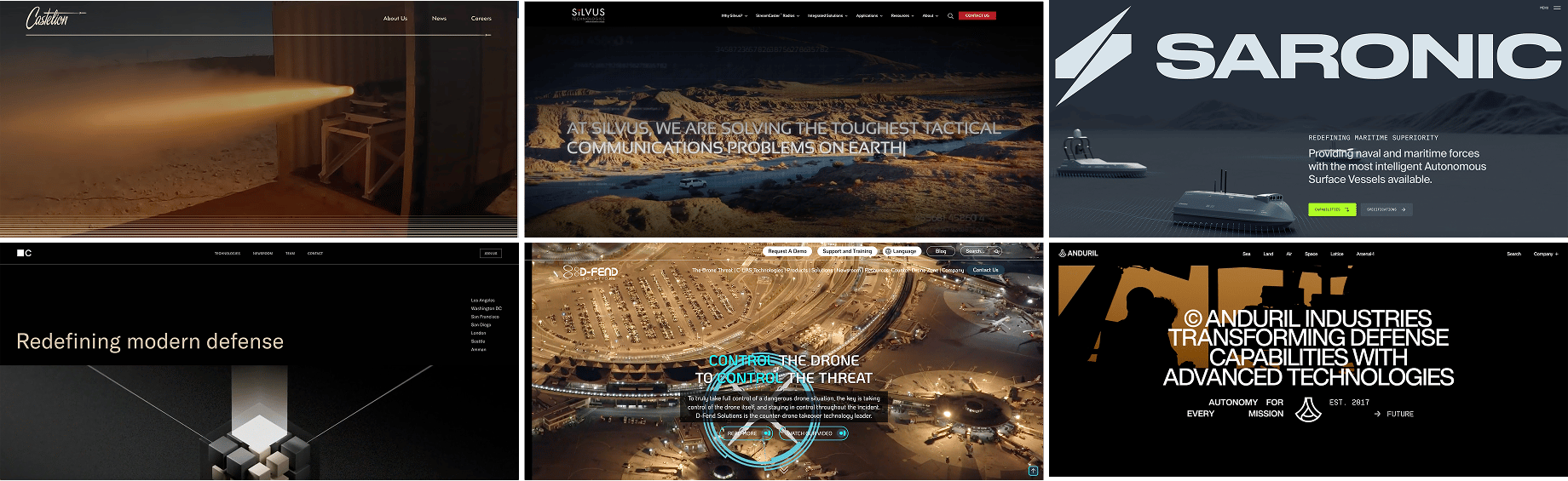
Defense & security
AI infrastructure and semiconductor companies typically highlight performance under strict constraints such as power consumption, manufacturing complexity, and scalability. Their visuals frequently include chip diagrams, system layers, and technical architecture.

AI Infra & Semiconductors
Energy, robotics, and manufacturing companies focus more on productivity and reliability. Their websites tend to show real environments, real machines, and real people working alongside technology.

Energy, Robotics & Manufacturing
What this research means for deep tech design
Across all the companies we studied, a few principles consistently appeared.
Deep tech websites are designed first and foremost to earn belief. Credibility must come before conversion, and clarity consistently outperforms clever marketing language.
Proof matters far more than persuasion. Visitors want to see real systems, real deployments, and real operational environments.
And perhaps most importantly, design is not simply decoration.
In deep tech, design functions as infrastructure for understanding—the layer that makes complex systems legible to the people evaluating them.
Studio SaltI run Studio Salt, a fractional design partner that serves early stage startups. | Founder design clinicI also review & critique founders’ product and design at FDC. |
Loving my content so far? I’d appreciate if you can share my newsletter to a friend 🙂